
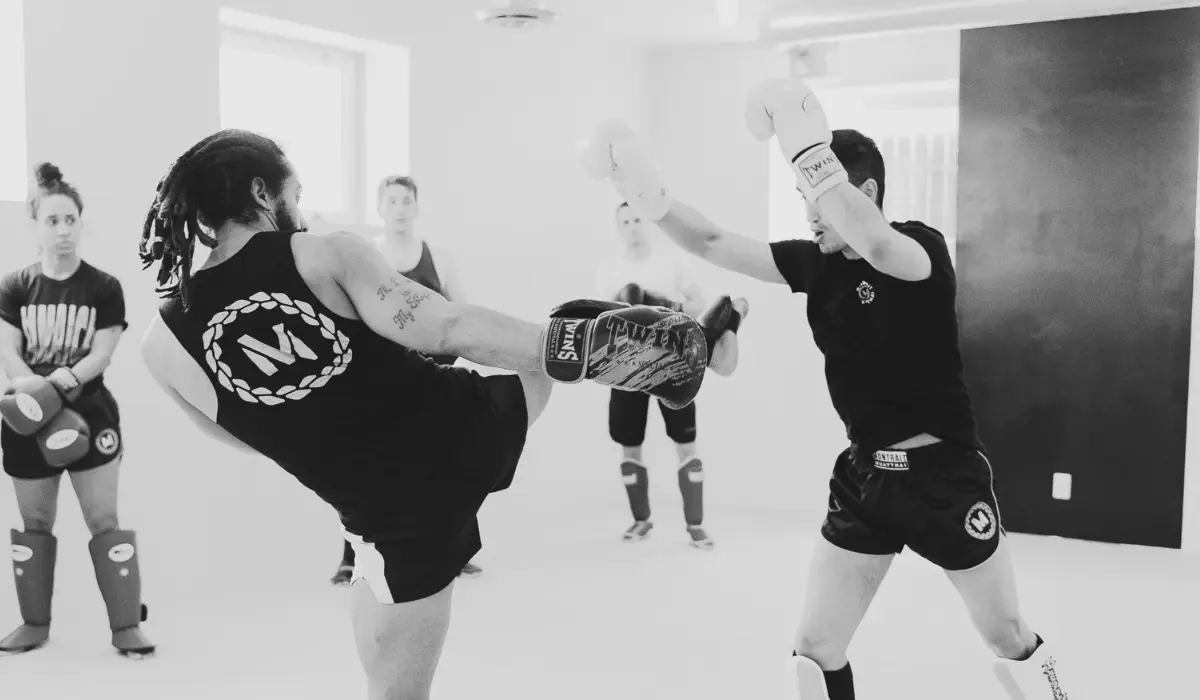
How To Manage Low Back Pain in Muay Thai?
You can spar, clinch, and drill kicks all week with no issue. Then your low back lights up halfway through a round for no obvious reason. You rest, stretch, and do core bracing exercises you found on the internet but somehow it keeps coming back.
In the past 16 years of my Muay Thai journey, I’ve heard this story hundreds of times: “I started getting busy at work/school and felt bad I wasn’t training as much so I did an intense workout. Now my back hurts when I bend or twist and I don’t know what to do.”
Most Muay Thai athletes dealing with back pain aren’t beginners and they aren’t careless. Many of them are busy professionals who only get a few sessions per week and want those sessions to count. Pain isn’t the most frustrating part of this experience. It’s the feeling that more training somehow isn’t creating more resilience. The solution? Train to improve resilience, not test it.
The Dominant Myth: “You Just Need a Stronger Core”
The usual advice sounds logical:
Brace more.
Strengthen your core.
Keep a neutral spine at all times.
That advice feels safe. In static environments it often is. But Muay Thai is not static. And that’s where this explanation falls apart.
Muay Thai culture rewards toughness. Train through it. Build conditioning. Get sharper under fatigue. That mindset works for skills and confidence but it often fails in the presence of pain and injury. More rounds don’t automatically fix how force moves through your body. They often just reinforce the same compensations at higher speed and fatigue.
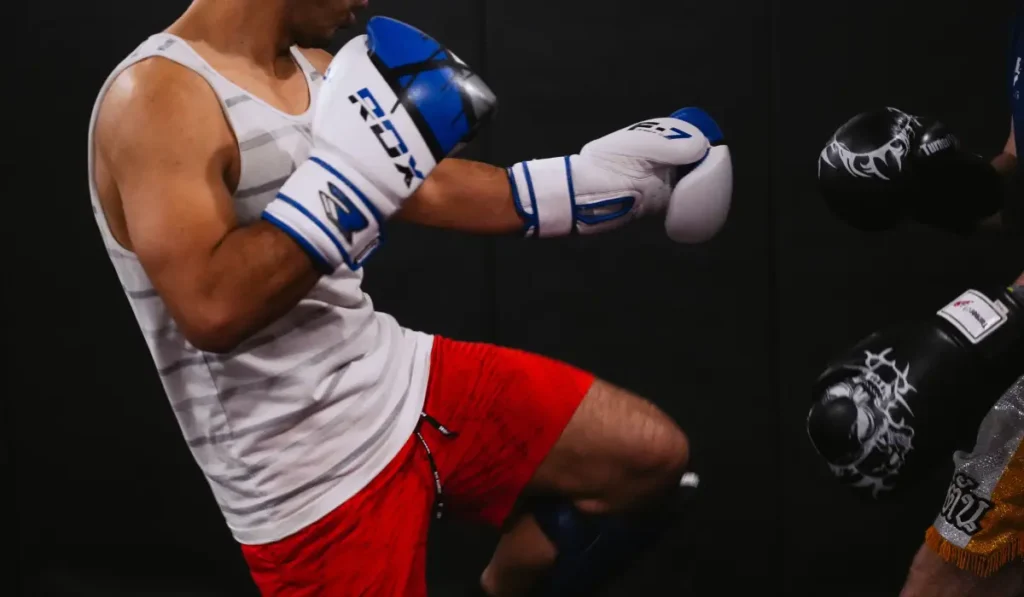
Core Concept of Muay Thai Training: Force Control Under Rotation
Low back pain in Muay Thai is about missing foundational control that should exist before intensity, speed, and volume are layered on. How force is transferred through the system when rotation, fatigue, and timing collide is what dictates your performance and injury risk.
Kicks, knees, checks, clinch work, and directional changes all require rotational force. Your spine isn’t meant to be rigid; it’s meant to manage and distribute load. When that control breaks down, the lower back becomes the path of least resistance.
An Analogy: Drive Shaft Problem
Imagine a drive shaft connecting an engine to the wheels. If the joints above and below it are well-aligned, the shaft transmits force smoothly. But if one joint loses timing or stability, the shaft absorbs stress it was never designed to handle.
The shaft doesn’t “fail” because it’s weak. It fails because the system around it stopped sharing load. Your low back works the same way.
Muay Thai Mechanics
In Muay Thai, force should flow:
From the ground → Through the hips → Across the trunk → Into the striking limb
When hip rotation is late, stance control degrades, or fatigue alters timing, the spine compensates.
This often shows up as:
- Back tightness after repeated kicks on one side
- Pain during clinch rounds, not during pad work
- Discomfort after class, not during the warm-up
None of this means your back is fragile. It means it’s over-functioning.
3 Reasons Why Common Solutions Fail:
1. Generic core training
Planks and anti-rotation drills improve capacity but they don’t address when and why you lose control under fight-specific fatigue.
2. Mobility-only approaches
Stretching can reduce tone temporarily, but it doesn’t change how force is managed when speed and reaction matter.
3. Technique cues alone
“Turn your hips more” or “brace harder” assumes the system is capable of doing that consistently under load. The problem is it isn’t and is often the reason your back hurts in the first place.
Group Training Often Misses This
Group classes optimize for flow, not fine tuning. Instructors manage groups, not individual mechanics under fatigue.
You can hide compensations well. Especially if you’re strong, conditioned, or experienced.
Foundational gaps don’t announce themselves loudly. They whisper; tightness, stiffness, late-session pain until volume exposes them.
None of this is a flaw in Muay Thai. It’s a limitation of your environment.
Self-Diagnosis: Signs You’d Benefit From Foundational 1-on-1 Work
You might recognize yourself if:
- Your back pain appears only after multiple rounds
- You feel solid early, unstable late
- One kick direction consistently irritates your back
- You “brace hard” to feel safe
- Strength training feels fine, sparring does not
These patterns point to control problems, not effort problems.
How Can 1-on-1 Foundational Muay Training Help?
Individual work isn’t about doing easier training. It’s about earning the right to train hard.
In a 1-on-1 setting, a Muay Thai coach can:
- Strip intensity down to observe force transfer
- Identify which joints aren’t contributing on time
- Rebuild stance, rotation, and load tolerance progressively
- Expose asymmetries that group training hides
- Re-test under fatigue, not just fresh conditions
As a Foundations Muay Thai coach at MMT, my job is to be your performance engineer. We test the mechanisms causing pain, assess fundamental movement and foundational Muay Thai technique to identify patterns linked to your pain, and then custom tailor your training to stabilize joints and create a stronger, more resilient body.
This is foundational training—not as regression, but as engineering.
Recover from Lower Back Pain in Toronto with MMT
Low back pain in Muay Thai isn’t a sign that you should stop training. It’s feedback that your system hasn’t been given the space to build a proper base. When you respect foundations and allow individual assessment to guide them you don’t train less. You train with a system that can handle what you’re asking of it.
The Montrait Muay Thai Philosophy
At Montrait Muay Thai, foundational work isn’t separate from sport. It’s how we make sports sustainable. We don’t chase perfect technique.We restore system reliability so intensity stops leaking into the spine. When the foundation is solid, Muay Thai stops aggravating the back and starts strengthening the system around it.Request a consultation today.