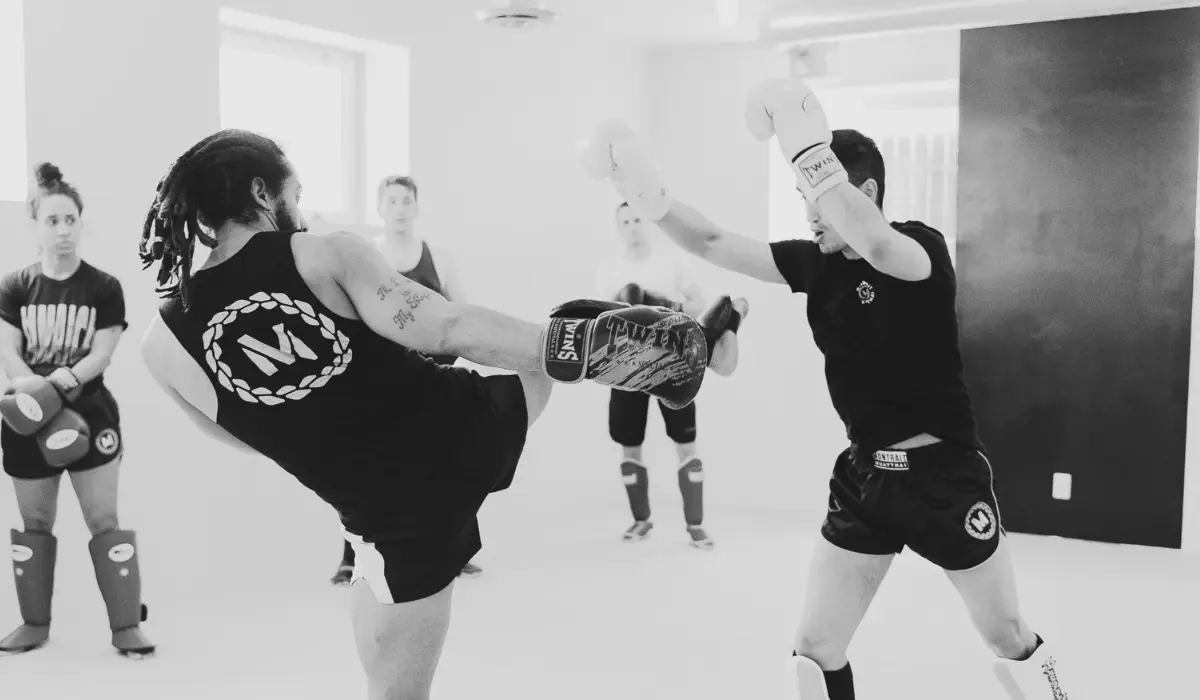

If you are searching “Muay Thai back pain,” you are probably wondering whether it is safe to start training.
Maybe your lower back gets stiff after sitting at a desk all day. Maybe you have had back pain in the past and you are nervous about kicking, punching, twisting, or clinching. Or maybe you tried a Muay Thai class before and hurt your back afterward.
So, can you train Muay Thai with back pain?
For many beginners, the answer is yes BUT the way you start matters.
Muay Thai is a physical sport. It involves mobility, stability, balance, footwork, core endurance, cardio, and full-body coordination. If your body is not distributing load well, your back may end up doing more work than it should
That does not automatically mean Muay Thai is bad for your back. It may mean your body needs a better entry point into training.
Why Does My Back Hurt During Muay Thai?
A lot of beginners assume that back pain means their back is weak.
Lower back pain means “I need to strengthen my back.” Knee pain means “I need stronger knees.” Shoulder pain means “I need stronger shoulders.”
Sometimes that is part of the picture. But the painful area is not always the weak link.
In Muay Thai, your body needs to work as a connected system. When you throw a kick, your lower back should not be the only area creating rotation. Your feet, hips, trunk, and shoulders all need to contribute. When you punch, power should transfer from the floor through the legs, pelvis, trunk, shoulder, and arm. When you knee, check, pivot, or defend, your body has to manage balance and force under changing conditions.
If one part of the system is not contributing well, another area has to pick up the slack.
Very often, the lower back becomes the overworked area.
That does not mean your back is “bad.” It means your movement strategy needs to change.
Muay Thai Back Pain Is Often a Coordination Problem
When people hear the word “coordination,” they usually think of being naturally athletic, fast, or graceful.
But for back pain, we are talking about coordination in a mechanical sense: does your body share load or transfer force well? Are the right joints and muscles contributing at the right time?
For example, if your hips cannot rotate freely, your back may feel tight after punching or kicking. If your stance isn’t balanced, your torso may brace excessively. If you are holding your breath or tensing too hard, your body may become too stiff to move smoothly.
This is why simply strengthening your lower back does not always solve the problem.
If the same overload pattern remains, the pain often comes back.
Is Muay Thai Safe for Beginners With Back Pain?
Muay Thai can be safe for beginners with back pain when the training is scaled properly.
The problem is not usually Muay Thai itself. The problem is being thrown into a class environment before your body has learned how to handle the positions, movements, and intensity.
A beginner with back pain may struggle if they are expected to keep up with everyone right away. They may not know how to stand, pivot, kick, punch, brace, breathe, or defend efficiently. Under fatigue, the body usually falls back into its strongest compensation patterns.
For many people, that means the lower back does too much.
This is why your starting point matters.

How Our IPS Helps Beginners With Back Pain
At Montrait Muay Thai, we do not believe in a sink-or-swim approach for beginners.
Our process starts with a consultation, followed by an Initial Performance Session, or IPS. The IPS is a 75-minute one-on-one session designed to understand how you move before we simply throw you into group training.
For someone dealing with back pain, we are not only asking, “Where does it hurt?”
We are looking at what your body is being asked to do too much of.
That may include your stance, hip rotation, trunk control, balance, footwork, kicking mechanics, punching mechanics, posture, breathing, or how you brace when learning something new.
The purpose of the IPS is to identify whether your back is truly the weak link, or whether it is compensating for something else.
Foundations For Muay Thai in Toronto
After the IPS, many beginners move into our Foundations program.
Foundations is a series of ten one-on-one sessions that teaches the fundamentals of Muay Thai in a structured, personalized way. Think of it as private tutoring for your body and your technique.
Instead of trying to survive a group class while worrying about your back, you learn step by step.
You learn how to stand, move, punch, kick, defend, and condition your body with better mechanics. You receive coaching specific to your body, your goals, and your current limitations.
For someone with back pain, this can make a major difference.
The goal is not to avoid hard training forever. The goal is to prepare your body to train well.
Muay Thai should challenge you. It should build strength, conditioning, skill, and confidence. But the challenge should be scaled intelligently so your body learns how to distribute work better.
Build Confidence With Beginner Muay Thai
If you are worried about training Muay Thai with back pain, it does not mean you are too weak, too injured, or too out of shape to start.
It may simply mean you need a better assessment and a better entry point.
Back pain often shows up where compensation accumulates. It is not always where the story starts.
At Montrait Muay Thai, our IPS and Foundations process helps beginners understand how their body moves, reduce guesswork, and build the confidence to train properly.
Because the goal is not just to get through your first class.
The goal is to build a body that can train, improve, and enjoy Muay Thai for the long term.
Book a no-sweat consultation call with us to talk through where you are at and what your fitness goals look like. There is no pressure and no commitment, but an opportunity to learn about how our training can help you reach your goals.
If you are searching “common Muay Thai injuries,” you are probably not looking for a reason to avoid training.
You are looking for a reason to start intelligently.
Maybe your back already gets tight from sitting. Maybe your shoulders feel stiff after work. Maybe your knees ache when you run, your shins flare up with impact, or your wrists feel uncomfortable when you do push-ups. You want to learn Muay Thai, but you do not want to turn a manageable ache into a bigger problem.
That concern is reasonable.
Muay Thai involves punching, kicking, kneeing, elbowing, rotating, balancing, impact, and fatigue. Injuries are not random. They usually happen when the body is asked to produce or absorb more force than it can currently control.
If any symptoms are sharp, worsening, radiating, associated with numbness, or affecting daily life, get assessed by a qualified healthcare professional before continuing training.
The goal is not to avoid all risks. The goal is to understand where risk comes from and make the body stronger in the right order.
Here are 5 Common Muay Thai Injuries in Beginners And How To Prevent Them:
1. Back Pain
Back pain is one of the most common concerns for adults starting Muay Thai.
Round kicks, punches, knees, and defensive movements all involve rotation. If the hips do not rotate well, especially into hip internal rotation, the low back often makes up the difference. Over time, that can turn the back into the “compensation zone.”
Poor core endurance can also contribute. This is not just about having visible abs or being able to hold a plank. It is about whether your trunk can maintain position, breathing, and control over repeated rounds. When fatigue builds, the ribs may flare, the pelvis may shift, and the low back may absorb force that should be distributed through the hips and trunk.
How to Treat:
- Reduce provocative movements: Pull back on high kicks, hard rotation, and any movement that directly triggers symptoms.
- Rebuild gradually: Reintroduce with lower-intensity drills before returning to full training load.
- Identify the root cause: Resting until pain calms down is not enough. Understand why the back was overloaded in the first place.
How to Prevent:
- Hip Mobility: Build usable hip rotation, especially internal rotation, so the low back is not compensating for a stiff hip.
- Core Endurance: Train the trunk to maintain position, breathing, and control across multiple rounds, not just in isolation.
- Kick Mechanics: Learn to kick through the hip instead of twisting through the low back.
- Load Management: Progress kicking height, power, and volume gradually rather than all at once.
2. Neck and Shoulder Pain
Many beginners already spend hours in rounded positions: sitting at a desk, driving, cooking, typing, or looking down at a phone.
Then they enter a Muay Thai stance: hands high, chin tucked, elbows in, shoulders active. This position is important defensively, but it can exaggerate existing neck and shoulder tension.
If the upper back is stiff and the shoulder blades do not move well, the rotator cuff may have to work from a poor base. The shoulder is like a crane mounted on a platform. If the platform is unstable, the moving arm has to compensate.
How to Treat:
- Reduce punching volume: Pull back if symptoms are increasing rather than pushing through.
- Avoid loading an unstable shoulder: Stay off heavy bag and pad rounds if the shoulder feels pinchy, weak, or unstable.
- Restore range first: Comfortable shoulder range, upper-back motion, and neck control should come before adding more speed or power.
- Seek assessment: Persistent pain, weakness, numbness, or pain that disrupts sleep warrants professional evaluation.
How to Prevent:
- Posture Tolerance: Build the capacity to hold a guard position without shrugging or tensing the neck.
- Upper Back Strength: Strengthen the upper back, rotator cuff, and shoulder blade control to give the shoulder a stable base.
- Punch Mechanics: Learn to support punching through the trunk, hips, and footwork rather than relying on the shoulder alone.
- Progressive Load: Build punching mechanics gradually before increasing speed or power.
3. Ankle Pain, Knee Pain, and Shin Splints
Footwork, skipping, kicking, pivoting, and conditioning all expose the lower body to repetitive impact.
The foot and ankle are the first contact points with the floor. If they do not absorb and redirect force well, stress travels up the chain into the shins, knees, hips, or back.
Balance matters here. Not just standing on one leg, but controlling pressure through the foot while moving. If the foot collapses, stays too rigid, or cannot adapt to the floor, the shin and knee may take more load than they can tolerate.
Shin splints often happen when training volume increases faster than the tissues can adapt.
How to Treat:
- Reduce impact volume: Modify skipping, running, jumping, and high-repetition kicking while symptoms are present.
- Ice irritated shins: Apply ice if it helps manage symptoms during the acute phase.
- Reintroduce load gradually: Do not return to full volume until the area can tolerate it without flaring.
- Seek assessment for acute injuries: If you cannot bear weight, the joint feels unstable or numb, pain is directly over bone, or symptoms are severe, get assessed professionally.
How to Prevent:
- Foot and Ankle Strength: Build the capacity to push through the floor without collapsing inward or gripping excessively.
- Single-Leg Balance: Improve control under load, not just static standing.
- Load Management: Progress skipping, pivoting, and kicking volume slowly to give tissues time to adapt.
- Footwear: Good footwear outside the gym matters if daily walking or work demands already irritate your shins or knees.
4. Sprained Wrist
Wrist injuries often happen when beginners punch with poor alignment or hit harder than their structure can support.
A punch is a force-transfer problem. Power should move from the floor, through the legs, hips, trunk, shoulder, arm, and fist. If the wrist bends on impact, the force does not travel cleanly. The wrist becomes the weak link.
Wraps and gloves help, but they do not replace technique.
How to Treat:
- Stop punching through wrist pain: Reduce impact work and avoid heavy bag or pad rounds until the wrist can tolerate basic loading.
- Early care for acute sprains: Rest, ice, compression, and elevation in the first few days.
- Seek assessment: Major swelling, bruising, loss of grip strength, deformity, numbness, or pain that does not improve warrants professional evaluation.
How to Prevent:
- Fist Position and Alignment: Learn correct wrist alignment and knuckle contact before increasing power.
- Hand Wraps and Gloves: Use properly fitted gloves and hand wraps consistently.
- Earn harder punching: Progress contact through clean mechanics, not enthusiasm.
5. Concussion
Concussion is the injury many beginners worry about most when they hear “combat sport.”
That concern should be respected.
At Montrait Muay Thai, beginners do not spar on day one. Sparring only occurs at the yellow shorts level, after students have developed enough technical control, defensive awareness, and coach approval to participate more safely.
Concussion risk is not about toughness. It is about exposure, control, defensive skill, decision-making, and preparation.
Reactive neck stability also matters. The neck helps control how the head moves when force is applied. This does not make anyone concussion-proof, but better neck strength, posture, awareness, and reaction can be part of a broader risk-reduction strategy.
How to Treat:
- Stop immediately: If a concussion is suspected, stop training that day. Do not return to sparring, drilling, or conditioning.
- Monitor symptoms: Headache, dizziness, nausea, light sensitivity, balance issues, fogginess, slowed thinking, or memory problems all warrant attention.
- Supervised return: Return to sport should be gradual and managed by a healthcare provider.
How to Prevent:
- Delay sparring: Sparring should be earned technically, not handed to beginners on day one.
- Build defensive skill first: Distance control, composure, and reaction come before unpredictable contact.
- Neck Stability: Strengthen and build awareness in the neck as part of broader injury-reduction work.
- Controlled sparring environment: Keep sparring supervised, controlled, and appropriate to the athlete’s current level.

How Montrait Muay Thai Reduces These Risks
The biggest mistake beginners make is starting with intensity before understanding their mechanics.
This is why our Toronto Muay Thai gym developed the Initial Performance Session (IPS) and Foundations curriculum: to help reduce injury risk by giving each new student an individualized starting point.
During the IPS, instead of assuming every beginner moves the same way, we look at how you rotate, balance, brace, breathe, strike, and tolerate basic Muay Thai positions. This helps identify root contributors behind existing aches and pains, rather than only reacting to symptoms.
From there, the 1-on-1 Foundations program builds technique progressively. You learn stance, footwork, punching mechanics, kicking mechanics, defense, balance, and control before being expected to keep up in a faster group environment. If your hips are limiting your kick, we address it. If your shoulders are tense in stance, we coach it. If your wrists need better punching structure, we slow the movement down. If your conditioning drops your technique, we progress volume carefully.
Muay Thai should challenge your body, not punish it for being unprepared.
When the starting point is assessed and the progression is coached, beginners can build skill, confidence, and resilience at the same time.
Start with a free intro call today!
If you are injured and want to return to Muay Thai, the answer is usually not to avoid loading your body.
It is to load your body better.
That may sound strange if you are dealing with a sore knee, cranky shoulder, irritated back, hip pain, or an old injury that keeps flaring up every time you try to train again. Most people assume rehab means backing off completely, doing a few gentle stretches, maybe adding some band exercises, and waiting until the pain disappears before they return to “real” training.
But that is not how the body becomes ready for Muay Thai again.
Why Muay Thai Demands More Than Rest
Muay Thai is a loaded sport. Every punch, kick, knee, elbow, clinch exchange, defensive movement, and footwork adjustment asks your body to absorb, redirect, and produce force. If rehab never prepares you for those demands, you may feel better at rest but still break down once you return to class.
That is why injury rehab needs load.
The key is applying the right amount of load, in the right way, at the right time.

Performance and Injury Prevention Are Not Separate Goals
A lot of people separate training into two categories: performance and injury prevention. Performance means getting stronger, faster, more powerful, more technical, and better conditioned. Injury prevention means doing corrective exercises, mobility drills, activation work, or isolated strengthening to avoid getting hurt.
At a surface level, that separation makes sense. But in practice, the qualities that improve performance and the qualities that improve resilience overlap heavily.
- A body that distributes load well usually performs better.
- A body that transfers energy efficiently usually strikes better.
- A body with more positional options usually moves better.
- A body that tolerates stress well usually recovers better.
- A body with fewer unnecessary compensations usually flares up less often.
These are not separate goals. They are the same process viewed from different angles.
How Load Travels Through a Strike
1. The Round Kick
Take a round kick as an example. If your standing foot, hip, trunk, and shoulder all coordinate well, the kick feels smoother and more powerful. Force travels through the body instead of getting stuck in one place. That helps performance.
But it also helps resilience. If your hip cannot contribute, your lower back may take more strain. If your standing leg cannot control rotation, your knee may become the weak link. If your trunk cannot manage the force of the kick, your shoulder or neck may tense up to create stability. Over time, one area keeps paying the price for a coordination problem somewhere else.
2. The Punch
The same idea applies to punching. A punch is not just your arm. It is a chain of force from the floor, through the legs, hips, trunk, shoulder blade, and fist. When that chain coordinates well, your punches are sharper and more efficient. When it does not, your shoulder, elbow, wrist, or neck may absorb stress they were not meant to handle repeatedly.
What a Good Muay Thai Return-to-Training Plan Actually Looks Like
This is why returning to Muay Thai after injury should not be built around avoiding every uncomfortable movement forever. It should be built around gradually restoring your ability to handle the movements the sport actually requires.
That does not mean rushing back into sparring, max-effort pad rounds, hard clinching, or high-volume kicking before you are ready. It means using progressive training to rebuild capacity.
Early Rehab
In early rehab, loading might be simple and controlled. You may need to restore basic strength, range of motion, balance, and confidence around the injured area.
Progressive Sport-Specific Loading
As your tolerance improves, the exercises should start to look more like the demands of Muay Thai. That progression might include:
- Rotational control
- Single-leg stability
- Trunk stiffness and relaxation
- Deceleration
- Footwork
- Striking mechanics
- Eventually, contact or higher-speed work
The Real Goal: A Body With Options
The point is not to move perfectly. Perfect movement does not exist in a live sport. Muay Thai is dynamic, messy, reactive, and unpredictable. You will not always be in an ideal position. Your opponent, partner, fatigue, timing, and distance will constantly change the task.
The real goal is to build a body that has options.
You want to be able to:
- Absorb force in different stances
- Rotate without dumping everything into your back
- Kick without irritating your hip or knee
- Frame and clinch without your neck or shoulder flaring up
- Change direction without feeling fragile
That requires more than generic “prehab.” It requires training that challenges the affected movement patterns in a progressive way.
Common Injury Patterns and What They Actually Need
If your shoulder hurts when punching, the answer is not always endless band pull-aparts. You may need to look at how your ribs, trunk rotation, scapular control, guard position, and punching volume interact.
If your knee hurts when kicking, the issue may not be the knee alone. It may involve foot position, hip rotation, stance width, balance, or how quickly you increased training volume.
If your back tightens up after every class, you may need better load distribution between your hips, trunk, and legs, not just more stretching.
Coaching and Programming Make A Real Difference
A good return-to-training plan should bridge the gap between rehab and sport. It should respect pain without being ruled by fear. It should reduce unnecessary stress on irritated tissues while progressively exposing them to more work. It should build strength, coordination, conditioning, and technical skill together.
Because the line between performance training and pain reduction is often much thinner than people think.
When your body coordinates well, you move better. When you move better, you waste less energy. When you waste less energy, you can train longer and recover better. When no single area is repeatedly forced to absorb more than its share, you become more durable.
Return to Muay Thai Training After Injury in Toronto
At Montrait Muay Thai, we have built a structured approach to helping members return to training after injury — one that does not sideline you indefinitely or rush you back before you are ready. Kru Ben Lee works directly with members across the Foundations and Advanced programs, applying the same biomechanics-grounded framework outlined in this post.
Whether you are dealing with a recurring flare-up or coming back after time away, the programming at MMT is built to meet you where you are and move you forward progressively.
Book a no-sweat consultation call with us to talk through where you are at and what a return-to-training path looks like for you. There is no pressure and no commitment, but an opportunity to learn about how our training can help you reach your fitness goals.
About Kru Ben Lee
Kru Ben holds a BASc in Mechanical Engineering and an MSc in Biomechanics from the University of Waterloo, and has trained in Muay Thai since 2010. His research on low back injury prevention and Muay Thai performance is published on ResearchGate.
If your gas tank dies in round two, it’s tempting to assume you just need to “get fitter.” So you add more runs, more circuits, more suffering. And somehow… you still feel flat when the pace spikes. Worse: your shins, hips, or low back start complaining long before your lungs do.
You’re Not Lazy. You’re Just Training the Wrong System.
Most driven athletes I see, as a Muay Thai coach in Toronto, are consistent. They hit pads, they spar, they run, and they’ll do whatever the program says.
But they also describe a familiar pattern:
- They can “work hard” for a long time… until the round turns into a scramble
- They feel fine in training, then drown under fight-paced exchanges
- They keep adding conditioning, and their joints get crankier, not stronger
That’s not a willpower issue, but a system-design issue.
The Dominant Myth: “Conditioning = Making Yourself Tired”
The common advice sounds logical: Muay Thai is hard, so I need hard conditioning. Which usually becomes random HIIT circuits, endless bag “burnouts,” and running until your legs feel like concrete.
The problem is that fatigue isn’t a training method. It’s a side effect. If you don’t know which energy system you’re targeting, and why, you get really good at being tired… without getting reliably better at fighting.
The Core Concept: Condition the Bottleneck, Not Your Ego
Muay Thai rounds are a repeat-effort problem: sustained output with short bursts of chaos.
That means you need conditioning that builds three overlapping capacities:
- Aerobic base (recovery between bursts and between rounds)
- Threshold / “high sustainable pace” (how hard you can work without spiraling)
- Alactic power (short explosive bursts without turning everything into sludge)
Now the only thing left is finding the right mix for you.
Three Engines, One Chassis
Think of your body like a hybrid powertrain:
- The aerobic engine is the big, efficient motor: not flashy, but it keeps the whole system stable.
- The threshold engine is cruising speed under load—fast enough to matter, sustainable enough to repeat.
- The alactic engine is the turbo: brief, violent acceleration.
Most people keep slamming the turbo… while the cooling system is undersized. Then they wonder why performance overheats in round two.
How Incorporate Them into Muay Thai Training:
Here are the conditioning methods that actually map onto the demands of the sport:
1) Aerobic Base: Easy Roadwork (Yes, Still)
Easy runs (or bike/row) build the recovery engine: better between-round recovery, better bounce between exchanges, and less “panic breathing.” This is why roadwork remains a staple in fight sports culture—even if it’s not “sexy.”
How it should feel: conversational pace, nose-breathable, you finish fresher than you started.
What it’s for: recovery capacity, durability, repeatability.
2) Tempo / Threshold: Controlled Hard, Not Max Hard
This is the missing link for a lot of Muay Thai athletes: efforts that are uncomfortable but repeatable. Think 12–25 minutes total of work in chunks (e.g., 3–5 minute blocks) where you can’t chat, but you’re not sprinting.
How it should feel: “I can hold this, but I don’t want to.”
What it’s for: raising the pace you can sustain without falling apart.

3) Fight-Specific Intervals: Pad/Bag Rounds With Intent
Pads and bag work are already conditioning tools when you structure them like a mechanical test: consistent round length, consistent rest, measurable output. Thai pad work and heavy bag training are cornerstone methods in Muay Thai preparation for exactly this reason.
Examples that work:
- 3 min on / 1 min off × 5–8 rounds (quality stays high)
- “Density” rounds: fixed time, fixed combo themes, track total reps
What it’s for: specific endurance + skill under fatigue (not just exhaustion).
4) Alactic Power: Short Sprints, Long Rest
If your issue is that you can’t explode repeatedly (hard entries, flurries, clinch turns), you need brief, high-power efforts with enough rest to stay powerful.
Examples:
- 6–10 second hill sprint / 60–90 seconds rest × 8–12
- 10-second bag blitz / 50–70 seconds easy movement × 8–10
What it’s for: preserving explosiveness without building junk fatigue.
5) Clinch Conditioning: The “Grip + Posture Tax”
Clinch is uniquely expensive: posture, isometrics, and repeated off-balancing. If you only run and do circuits, you’re not paying the same tax.
Better options:
- Timed clinch rounds with constraints (pummel + posture + turns)
- “Isometric repeats” (short holds, frequent resets) that don’t trash your neck
Find Your Conditioning System’s Weakest Link:
You likely need more aerobic base if:
- Your breathing stays high long after rounds end
- You feel “gassed” even when you’re not working that hard
- You struggle to recover day-to-day
You likely need more threshold work if:
- You can go easy forever, but moderate-hard pace crushes you
- You fade halfway through a round even without big sprints
- Your output drops sharply after the first exchange
You likely need more alactic power if:
- Your first burst is great, the second is trash
- Your footwork gets heavy after a few hard entries
- You avoid explosive exchanges because they “cost too much”
How to Sequence a Good Conditioning Routine?
Good conditioning is sequenced, not stacked:
- Build the aerobic engine so you can recover
- Raise threshold so your “default pace” climbs
- Add alactic power so bursts stay sharp
- Use pads/bag/clinch as specific tests, not punishment
This is the same logic we use in assessment-driven coaching: identify the bottleneck, apply the minimum effective dose, retest, and progress based on what changes—not what feels heroic.
Condition Correctly at Montrait Muay Thai
If your Muay Thai conditioning hasn’t translated, don’t assume it’s because you’re not fit. Assume your system is mis-specified.
When your training methods match the energy demands of the sport, and your current constraint, you don’t just last longer. You fight clearer, you move cleaner, and you stop paying for fitness with your joints.
At Montrait Muay Thai, we build your conditioning through skill work, pad rounds, and structured drills. We build repeatable output, not burnout workouts.Book a call and tell us your goals and training history. One of our coaches will map out your first month of training.
You can spar, clinch, and drill kicks all week with no issue. Then your low back lights up halfway through a round for no obvious reason. You rest, stretch, and do core bracing exercises you found on the internet but somehow it keeps coming back.
In the past 16 years of my Muay Thai journey, I’ve heard this story hundreds of times: “I started getting busy at work/school and felt bad I wasn’t training as much so I did an intense workout. Now my back hurts when I bend or twist and I don’t know what to do.”
Most Muay Thai athletes dealing with back pain aren’t beginners and they aren’t careless. Many of them are busy professionals who only get a few sessions per week and want those sessions to count. Pain isn’t the most frustrating part of this experience. It’s the feeling that more training somehow isn’t creating more resilience. The solution? Train to improve resilience, not test it.
The Dominant Myth: “You Just Need a Stronger Core”
The usual advice sounds logical:
Brace more.
Strengthen your core.
Keep a neutral spine at all times.
That advice feels safe. In static environments it often is. But Muay Thai is not static. And that’s where this explanation falls apart.
Muay Thai culture rewards toughness. Train through it. Build conditioning. Get sharper under fatigue. That mindset works for skills and confidence but it often fails in the presence of pain and injury. More rounds don’t automatically fix how force moves through your body. They often just reinforce the same compensations at higher speed and fatigue.

Core Concept of Muay Thai Training: Force Control Under Rotation
Low back pain in Muay Thai is about missing foundational control that should exist before intensity, speed, and volume are layered on. How force is transferred through the system when rotation, fatigue, and timing collide is what dictates your performance and injury risk.
Kicks, knees, checks, clinch work, and directional changes all require rotational force. Your spine isn’t meant to be rigid; it’s meant to manage and distribute load. When that control breaks down, the lower back becomes the path of least resistance.
An Analogy: Drive Shaft Problem
Imagine a drive shaft connecting an engine to the wheels. If the joints above and below it are well-aligned, the shaft transmits force smoothly. But if one joint loses timing or stability, the shaft absorbs stress it was never designed to handle.
The shaft doesn’t “fail” because it’s weak. It fails because the system around it stopped sharing load. Your low back works the same way.
Muay Thai Mechanics
In Muay Thai, force should flow:
From the ground → Through the hips → Across the trunk → Into the striking limb
When hip rotation is late, stance control degrades, or fatigue alters timing, the spine compensates.
This often shows up as:
- Back tightness after repeated kicks on one side
- Pain during clinch rounds, not during pad work
- Discomfort after class, not during the warm-up
None of this means your back is fragile. It means it’s over-functioning.
3 Reasons Why Common Solutions Fail:
1. Generic core training
Planks and anti-rotation drills improve capacity but they don’t address when and why you lose control under fight-specific fatigue.
2. Mobility-only approaches
Stretching can reduce tone temporarily, but it doesn’t change how force is managed when speed and reaction matter.
3. Technique cues alone
“Turn your hips more” or “brace harder” assumes the system is capable of doing that consistently under load. The problem is it isn’t and is often the reason your back hurts in the first place.
Group Training Often Misses This
Group classes optimize for flow, not fine tuning. Instructors manage groups, not individual mechanics under fatigue.
You can hide compensations well. Especially if you’re strong, conditioned, or experienced.
Foundational gaps don’t announce themselves loudly. They whisper; tightness, stiffness, late-session pain until volume exposes them.
None of this is a flaw in Muay Thai. It’s a limitation of your environment.
Self-Diagnosis: Signs You’d Benefit From Foundational 1-on-1 Work
You might recognize yourself if:
- Your back pain appears only after multiple rounds
- You feel solid early, unstable late
- One kick direction consistently irritates your back
- You “brace hard” to feel safe
- Strength training feels fine, sparring does not
These patterns point to control problems, not effort problems.
How Can 1-on-1 Foundational Muay Training Help?
Individual work isn’t about doing easier training. It’s about earning the right to train hard.
In a 1-on-1 setting, a Muay Thai coach can:
- Strip intensity down to observe force transfer
- Identify which joints aren’t contributing on time
- Rebuild stance, rotation, and load tolerance progressively
- Expose asymmetries that group training hides
- Re-test under fatigue, not just fresh conditions
As a Foundations Muay Thai coach at MMT, my job is to be your performance engineer. We test the mechanisms causing pain, assess fundamental movement and foundational Muay Thai technique to identify patterns linked to your pain, and then custom tailor your training to stabilize joints and create a stronger, more resilient body.
This is foundational training—not as regression, but as engineering.
Recover from Lower Back Pain in Toronto with MMT
Low back pain in Muay Thai isn’t a sign that you should stop training. It’s feedback that your system hasn’t been given the space to build a proper base. When you respect foundations and allow individual assessment to guide them you don’t train less. You train with a system that can handle what you’re asking of it.
The Montrait Muay Thai Philosophy
At Montrait Muay Thai, foundational work isn’t separate from sport. It’s how we make sports sustainable. We don’t chase perfect technique.We restore system reliability so intensity stops leaking into the spine. When the foundation is solid, Muay Thai stops aggravating the back and starts strengthening the system around it.Request a consultation today.
When I first started training Muay Thai in Toronto, after about a year and a half I began working with some of the top professional fighters in Canada. One of the things we would do as a warm-up, a cool-down, before training, after training, even in the middle of training was something called technical sparring.
We’d engage in this technical play with high intent and high intensity, but very low impact and extremely controlled. That period of my training in Toronto changed everything. I learned more in that phase than at any other point in my martial arts journey. My timing, my rhythm, my understanding of distance, my defensive reactions all of it grew rapidly because of technical sparring. And the lessons I learned during that time have stayed with me for the next 17 years. I still use them today, and they remain some of the most valuable tools I’ve ever picked up.
What Makes Technical Sparring Different?
Unlike traditional sparring, which often involves full gear and high speed, technical sparring slows the exchange down. The goal isn’t to “win the round” but to learn from it. Both partners work at a light, intentional pace, focusing on distance, rhythm, accuracy, and decision-making rather than power.
This shift in mindset transforms sparring from a stressful experience into an educational one.
Why Technical Sparring Is So Effective
Technical sparring plays a big role in how students grow inside any solid Muay Thai Toronto program.
1. Learn the Rhythm of a Real Fight
Muay Thai has a natural rhythm, a flow and technical sparring teaches you how to feel it. Partners move together, attacking and responding like a conversation. This helps you understand who controls the pace and how to disrupt your opponent’s timing.
2. Build Accuracy and Control
With less chaos, you can think clearly and place your shots deliberately. You learn how to land cleanly without hurting your partner and how to avoid collisions with smart defensive reactions.
3. Increase Skill Repetition Without Damage
The more repetitions you get, the faster your fight IQ develops. Technical sparring gives you hundreds of realistic exchanges without the cost of injury, fatigue, or survival-mode stress.
4. Sharpen Feints, Setups, and Reactions
A slower pace allows you to practise drawing out defensive reactions and exploiting them. This is the foundation of high-level Muay Thai.
5. Build Confidence for Beginners
New students can inoculate themselves to the intensity of sparring. When you know the pace is light and controlled, fear drops and learning skyrockets.
6. Realistic Contact for Advanced Students
Experienced practitioners, especially those sparring without shinguards learn to stay calm while weapons come at them with minimal padding. This builds composure and authentic defensive habits.

Best Practices for Technical Sparring
- Start with shinguards and no gloves. Nails clipped, palm strikes only, fingers pulled back to avoid pokes.
- Match your partner’s rhythm. Think of it like a conversation, not a fight, but an exchange of ideas.
- Slow everything down. Aim for 50–60% pace while focusing on clean technique and clear intention.
- Avoid shin-to-shin collisions. Reduce impact by flexing the leg or slightly internally rotating on contact.
- Underreact rather than overreact. Excessive movement leads to openings and unnecessary collisions.
- Maintain playful seriousness, lighthearted energy with real purpose behind every movement.
How We Use Technical Sparring at Our Toronto Muay Thai Gym
At Montrait Muay Thai, technical sparring is woven directly into how we train. We often use it as a warm-up before full sparring rounds because it gets students thinking about timing, rhythm, and clean technique without the stress of heavy contact. It’s also one of the best tools we have for integrating newer students into sparring. Instead of being thrown straight into fast, high-pressure rounds, they get a safe, structured way to learn the flow of real exchanges.
We also use technical sparring as a cool-down at times, especially because it allows for meaningful practice without adding unnecessary damage or fatigue. Students get the chance to rack up a huge number of quality repetitions building a bigger and more adaptable “movement database” while staying relaxed and injury-free.
In short, technical sparring isn’t just something we do occasionally; it’s a core part of our training philosophy. It keeps the learning curve steep, the injury rate low, and the art of Muay Thai accessible to everyone on the mats.
Start Your Muay Thai Training In Toronto Today
Start your journey at Montrait Muay Thai and learn real technique in a supportive Toronto community. Train with coaches who focus on timing, control, and skill development so you can grow with confidence. Contact us today for a free consultation.
You’ve probably heard the saying: “It takes 4 weeks for you to notice changes, 8 weeks for those close to you, and 12 weeks for the rest of the world.”
But let’s be honest here – training for Muay Thai is a long journey, and sometimes, progress feels frustratingly slow. That’s because you’re not just trying to build muscles or abs, you’re learning how to perfect Muay Thai techniques correctly and with precision.
Here’s how you can stay committed, push through the slow times:
1. Remember Why You Started
When you start losing hope, it’s time to take a step back. Why did you start training for Muay Thai? Was it to learn self-defense, get fitter, or gain confidence? Are you stronger now? Do you feel less tired on a day-to-day basis?
Did you struggle to make it through your first session? Are you more comfortable with certain moves now? These little victories matter.
2. Set Smaller, Realistic Goals
There’s a lot to learn in Muay Thai but perseverance is one of the biggest things. While goals keep us motivated and on track, don’t get too hung up on big ones like winning fights or mastering advanced techniques overnight. Start with smaller goals like improving your footwork or landing a clean kick.
3. Track Your Progress
Keep a training journal or app. Write down what you’re working on, how each session went, and any feedback you received from your coach. A lot of improvements in Muay Thai are subtle but when you track progress actively, you’ll notice them easily.

4. Surround Yourself With Positive People
When your circle is made up of people who believe in you, it’s easier to believe in yourself. If you’re training with people who constantly put themselves down or criticize others, you’ll start to do the same. It’s okay to set boundaries.
5. Embrace the Journey, Not Just the Destination
Instead of being fixated on the end, learn to love the process. Celebrate the effort you’re putting in, the sweat you’re leaving on the mat, and the small improvements you’re making daily. Muay Thai is about the journey, not just the results. You’re growing every day, even if the growth isn’t immediately visible.
6. Mix Up Your Training Routine
If you’re starting to feel stuck, it might be time to mix things up. Try different drills, work with new partners, or focus on the more difficult parts of your training. Sometimes, it’s just a mental plateau that you have to break to see results physically.
7. Accept That Progress Isn’t Linear
Some days you feel unstoppable; other days, you struggle to get anything right. This is completely normal. Understand that bad days don’t define your overall ability. They’re part of the process, and every martial artist experiences them.
8. Visualize Your Success
Is there a drill or technique that you’ve not tried yet? Any complicated move that keeps you from stepping into the ring with confidence? Before you begin training, close your eyes for a couple minutes and create a picture mentally of you doing it finally. It’s more or less like manifestation but for physical training.
9. Take Care of Your Body
If you’re not seeing results, it’s time to go back to the basics. Are you eating well? Getting enough rest? When was the last time you took a day off training? Your body might be burned out and just needs some rest. Eat balanced meals with high protein, stay hydrated, and listen to your body. Instead of Muay Thai training, go for a brisk walk or run. It keeps you active but is much lower in intensity.
Got more questions? We’re here for you!
You’ve felt it—the burn in your lungs, the heaviness in your legs, the frustration of wanting to keep going but feeling like your body has hit a wall. You’ve probably wondered, “how do I make myself go longer?” Building stamina for Muay Thai isn’t just about running more or doing endless drills. You want to go the distance, to throw those combos with power until the final round, and to feel strong until the very end.
Here are 8 no-nonsense tips to build stamina for Muay Thai training:
1. Incorporate Roadwork into Your Routine
Roadwork remains a staple in most combat sports, and for good reason. Running improves cardiovascular endurance, which helps you maintain consistent energy levels throughout a Muay Thai session. Start running at a steady pace for 3 to 5 kilometres and can maintain that, throw in some sprints or hill runs. Focus on consistency over speed. As you get better with endurance, you’ll be able to sustain high-intensity activities for longer periods.
2. High-Intensity Interval Training (HIIT)
During HIIT workouts, you perform short bursts of intense exercise followed by a quick rest, almost like Muay Thai. Incorporate HIIT in your workout routine anywhere from 1-3 times a week. You’ll also build lean muscles to support your Muay Thai training.
3. Jump Rope Regularly
Jumping ropes helps with many endurance-related components at once – cardiovascular health, footwork, and timing. With consistent practice you’ll become lighter on your feet, which directly impacts your performance in the ring. Build yourself up to 3 minutes of non-stop jumping ropes.
4. Add Circuit Training to Your Regimen
Circuit training combines different exercises in quick succession, great for mental and physical coordination. You can design a circuit that benefits you the most. Some exercises we recommend are push-ups, burpees, sit-ups, and kettlebell swings. Make sure to not take breaks that are longer than 30 seconds. Circuit training mimics the physical demands of a fight, where you need to switch between offensive and defensive moves rapidly.

5. Incorporate Plyometric Exercises
Plyometric exercises, like box jumps and clap push-ups, help increase power and explosiveness. They force your muscles to exert maximum force in short intervals and also improve your fast-twitch muscle fibres, essential for quick movements and strikes.
6. Practice Sparring and Pad Work
Nothing builds Muay Thai-specific stamina better than actual sparring and pad work. Sparring with partners of varying skill levels also challenges your endurance. When practising pad work, Focus on throwing combinations that push your cardiovascular limits.
7. Work on Your Core
A strong core stabilises your body, helps you generate power, and maintain balance during strikes. Core exercises like planks, Russian twists, and leg raises are all great additions. It also takes away all the strain from your lower back and legs and in turn, you maintain proper form and conserve more energy.
8. Learn Proper Breathing Techniques
Deep, controlled breaths will help you last much longer than short, shallow breaths. Practice breathing techniques during shadow boxing or light pad work. Inhale through your nose and exhale through your mouth, and time your breaths with your movements.
Frequently Asked Questions
How does circuit training translate to fight-round endurance?
Circuit training conditions your body to push through high intensity without long breaks. That’s exactly what happens in the ring. Each station forces different muscle groups to work under fatigue, the same way combinations and clinching test you in rounds. When you do circuits with minimal rest, your body adapts to recover faster between explosive efforts.
What breathing techniques help reduce fatigue during Muay Thai sparring?
Keep your breath controlled and not forced. Between exchanges, focus on steady nasal breathing to bring your heart rate down. Many fighters gas out because they hold their breath when throwing combinations. You must stay relaxed in the shoulders, time your breathing with your strikes, and reset quickly in the clinch.
What’s the best running plan (distance, pace) to improve cardio for Muay Thai?
Mix long runs with sprints. Aim for 5–8 km steady runs three times a week at a conversational pace. This builds aerobic endurance. Add 100–200 meter sprints twice a week, with short rests, to mimic the burst of a fight.
How often should I do HIIT versus roadwork when training for Muay Thai?
Roadwork is your foundation, so do it three times a week. HIIT is your sharpener, so do it one or two times. Too much HIIT burns you out and makes it hard to recover for skill sessions. Roadwork gives you steady endurance, HIIT trains your ability to explode and recover. Use both, but never let HIIT replace the base conditioning that roadwork builds.
Train at Montrait Muay Thai in Toronto
We focus on fundamentals first, so you feel strong and equipped with the right techniques.
At Montrait Muay Thai, every student begins with an Initial Performance Session (IPS). One of our coaches will assess how your body moves, talk about Muay Thai and your training goals.
From there, you’ll work with a coach in private sessions to learn the fundamentals at your own pace.
By the time you join group classes, you’ll feel confident in your form, technique, and understanding of Muay Thai.
We’re excited to talk more. Book your IPS today.
All-inclusive trips, cruises, and international trips are fun and so needed to break the monotony of everyday hustle. But we’ve got a new kind of travel experience for you! Whether you’re a martial arts novice or have been training for years, gyms and clubs across the globe will welcome you with open arms to train with them. Build an itinerary around martial arts, while still soaking in the local culture and food. We’ve shortlisted 7 best destinations that offer the experience of a lifetime:
1. Phuket, Thailand
Phuket is known for its beautiful beaches and vibrant nightlife, but also has some of the best Muay Thai training camps in the world. It only makes sense because Muay Thai originated in Thailand. You can train with former champions and experience authentic Thai culture, from delicious street food to traditional festivals. BKK, Sinbi Muay Thai, and Phuket Muay Thai are some of the gyms we recommend you check out.
2. Toronto, Canada
Whether you’re interested in Muay Thai, Brazilian Jiu-Jitsu, or Mixed Martial Arts (MMA), Toronto has top-tier gyms and instructors. It is one of the most multicultural cities in the world, so you’ll get to try most martial arts from around the world in Toronto. Plan your visit during summer, so you can attend Caribana, Pride Parade, and Toronto Jazz Festival. Our Muay Thai gym in Little Portugal looks forward to seeing you for a class or two! Toronto BJJ is a great place to train as well.
3. San Jose, Costa Rica
San Jose offers a unique blend of martial arts training and eco-tourism. If you don’t want to DIY the trip, San Jose has an all-inclusive club for you. Instead of eating all you want and putting on a few pounds, you’ll be back from this trip in the best shape you’ve been. After training, they take you to explore Costa Rica’s stunning natural landscapes, including rainforests, volcanoes, and pristine beaches.

4. Tibet
Tibet is a spiritual haven for martial artists seeking deeper connections with their practice. Known for its serene landscapes and rich Buddhist heritage, Tibet has some of the best Kung Fu and Tai Chi clubs. A lot of training in Tibet is focused on the mental and spiritual aspects of martial arts. You’ll feel the spiritual abundance and find yourself relaxed and happy.
5. Amsterdam, Netherlands
This city might surprise you but Amsterdam has a thriving martial arts scene, particularly for Brazilian Jiu-Jitsu, judo and kickboxing. Tang Soo Do is another popular martial art in the Netherlands.
6. Rio de Janeiro, Brazil
Rio de Janeiro is synonymous with Brazilian Jiu-Jitsu (BJJ). It is home to some of the world’s most renowned BJJ academies. Rio’s beaches, samba music, and Carnival celebrations provide a lively backdrop to your martial arts journey. Locals are friendly and will even invite for house parties. Brazilian Black Belt, Mauro Ayres Jiu-Jitsu, and Equipe Fabricio Jiu-Jitsu welcome trainees at all levels.
7. Tokyo, Japan
Karate, Judo, Aikido, and Kendo are some of the martial arts you’ll find in Tokyo. You’ll find dojos everywhere in Tokyo but not all are welcoming to foreigners. Before you plan your trip, email the clubs you want to train at about their policies. Earning respect and acceptance is a big part of Japanese culture. When you aren’t training, explore local markets, temples, and meet new people.
Any destination you pick, travel with an open mind and open heart. Make memories and come back stronger!
Top-Rated Muay Thai Gym in Toronto
Discover a training experience built to help beginners feel confident and progress at their own pace.
At Montrait Muay Thai, every student begins with an Initial Performance Session (IPS). One of our coaches will assess how your body moves, talk about Muay Thai and your training goals.
From there, you’ll work with a coach in private sessions to learn the fundamentals at your own pace.
By the time you join group classes, you’ll feel confident in your form, technique, and understanding of Muay Thai.
We’re excited to talk more. Book your IPS today.
Muay Thai is one of the most powerful martial arts out there that also doubles as an intense workout. Also known as the “Art of Eight Limbs,” it can help you build muscles for both strength and aesthetic purposes without bulking too much. From the legs and core to the upper body and hips, our Muay Thai gym in Downtown Toronto can help you transform.
Here are 5 muscle groups that strengthen through Muay Thai training:
1. Leg Muscles
In Muay Thai, leg training is the foundation for powerful kicks and stability. The primary muscles that are targeted include the quadriceps, hamstrings, and calves.
Quadriceps: Every kick and knee strike in Muay Thai engages the quadriceps. With regular training, you can build more defined quads. These muscles also support your stance and movement, essential for maintaining balance.
Hamstrings: Kicking and kneeing actions also strengthen the hamstrings. These muscles help in extending the hip and bending the knee, which contributes to flexibility and better balance.
Calves: The constant movement, whether it’s shuffling, jumping, or pivoting, works the calves intensely. Strong calves contribute to explosive power in kicks and quick footwork and boosts your agility and speed.
2. Core Muscles
Like any other workout regime, you need a strong core to generate a powerful punch and balance yourself. Muay Thai helps you strengthen the abdominals, obliques, and lower back muscles.
Abdominals: Every punch, kick, and knee strike begins from the core. Muay Thai training involves a lot of twisting and turning, which targets the abdominal muscles. With the right diet, you can achieve a well-defined six-pack.
Obliques: The oblique muscles assist in rotational movements and stabilization. Muay Thai’s twisting motions, such as in hooks and roundhouse kicks, engage the obliques. It builds better-defined side muscles and improves rotational flexibility.
Lower Back: A strong lower back supports overall core strength and stability. Movements like clinching and throwing knees are recommended as they engage the lower back muscles to improve posture and reduce the risk of injury.

3. Upper Body Muscles
You’ll use your upper body during punching, elbow strikes, and clinching. Key muscles include the shoulders, chest, and arms.
Shoulders: Shoulders endure a significant amount of strain during training. Punching and elbow strikes target the deltoid muscles, which will help you build strong shoulders needed for more powerful and faster strikes.
Chest: The chest muscles, particularly the pectorals, are engaged during punching and clinching. A strong chest not only drives powerful punches but also helps in controlling opponents during clinching.
Arms: The biceps and triceps are continuously worked through various striking and defensive techniques. Training in Muay Thai develops arm strength and endurance and higher blocking ability.
4. Back Muscles
Back muscles contribute to proper posture and of course, deliver those powerful strikes. The muscles you should focus on include the latissimus dorsi, trapezius, and rhomboids.
Latissimus Dorsi: Strong lats support powerful strikes and improve the ability to control opponents during clinching.
Trapezius: The trapezius muscles, located in the upper back, are activated during striking and defensive movements.
Rhomboids: Located between the shoulder blades, the rhomboids contribute to scapular retraction, stabilization, and overall upper body strength.
5. Hip Muscles
The hip muscles, including the glutes and hip flexors, are needed for the kicking power and agility.
Glutes: Powerful kicks rely heavily on the glute muscles. They are engaged in every kicking motion, so the stronger your glutes are, the more explosive your strikes will be.
Hip Flexors: The hip flexors are involved in lifting the knee for kicks and knee strikes. Strong hip flexors means higher and more powerful kicks.
Benefits Beyond Muscle Building
Every session pushes your body in ways that regular workouts cannot. You build endurance, coordination, and mental sharpness while enjoying a dynamic, skill-based routine that never feels repetitive.
Here’s other ways Muay Thai helps you:
- Cardiovascular endurance: High-intensity rounds train your heart and lungs, boosting stamina for both training and daily life.
- Flexibility and mobility: Constant kicks, pivots, and clinching movements improve your range of motion and reduce stiffness.
- Coordination and balance: Practicing strikes while defending sharpens timing and body control.
- Agility and reflexes: Quick combinations and footwork drills train you to move with speed and precision.
- Mental focus: Muay Thai demands concentration, helping you clear distractions and build discipline.
Top-Rated Muay Thai Gym in Toronto
Discover a training experience built to help beginners feel confident and progress at their own pace.
At Montrait Muay Thai, every student begins with an Initial Performance Session (IPS). One of our coaches will assess how your body moves, talk about Muay Thai and your training goals.
From there, you’ll work with a coach in private sessions to learn the fundamentals at your own pace.
By the time you join group classes, you’ll feel confident in your form, technique, and understanding of Muay Thai.
We’re excited to talk more. Book your IPS today.