
If your gas tank dies in round two, it’s tempting to assume you just need to “get fitter.” So you add more runs, more circuits, more suffering. And somehow… you still feel flat when the pace spikes. Worse: your shins, hips, or low back start complaining long before your lungs do.
You’re Not Lazy. You’re Just Training the Wrong System.
Most driven athletes I see, as a Muay Thai coach in Toronto, are consistent. They hit pads, they spar, they run, and they’ll do whatever the program says.
But they also describe a familiar pattern:
- They can “work hard” for a long time… until the round turns into a scramble
- They feel fine in training, then drown under fight-paced exchanges
- They keep adding conditioning, and their joints get crankier, not stronger
That’s not a willpower issue, but a system-design issue.
The Dominant Myth: “Conditioning = Making Yourself Tired”
The common advice sounds logical: Muay Thai is hard, so I need hard conditioning. Which usually becomes random HIIT circuits, endless bag “burnouts,” and running until your legs feel like concrete.
The problem is that fatigue isn’t a training method. It’s a side effect. If you don’t know which energy system you’re targeting, and why, you get really good at being tired… without getting reliably better at fighting.
The Core Concept: Condition the Bottleneck, Not Your Ego
Muay Thai rounds are a repeat-effort problem: sustained output with short bursts of chaos.
That means you need conditioning that builds three overlapping capacities:
- Aerobic base (recovery between bursts and between rounds)
- Threshold / “high sustainable pace” (how hard you can work without spiraling)
- Alactic power (short explosive bursts without turning everything into sludge)
Now the only thing left is finding the right mix for you.
Three Engines, One Chassis
Think of your body like a hybrid powertrain:
- The aerobic engine is the big, efficient motor: not flashy, but it keeps the whole system stable.
- The threshold engine is cruising speed under load—fast enough to matter, sustainable enough to repeat.
- The alactic engine is the turbo: brief, violent acceleration.
Most people keep slamming the turbo… while the cooling system is undersized. Then they wonder why performance overheats in round two.
How Incorporate Them into Muay Thai Training:
Here are the conditioning methods that actually map onto the demands of the sport:
1) Aerobic Base: Easy Roadwork (Yes, Still)
Easy runs (or bike/row) build the recovery engine: better between-round recovery, better bounce between exchanges, and less “panic breathing.” This is why roadwork remains a staple in fight sports culture—even if it’s not “sexy.”
How it should feel: conversational pace, nose-breathable, you finish fresher than you started.
What it’s for: recovery capacity, durability, repeatability.
2) Tempo / Threshold: Controlled Hard, Not Max Hard
This is the missing link for a lot of Muay Thai athletes: efforts that are uncomfortable but repeatable. Think 12–25 minutes total of work in chunks (e.g., 3–5 minute blocks) where you can’t chat, but you’re not sprinting.
How it should feel: “I can hold this, but I don’t want to.”
What it’s for: raising the pace you can sustain without falling apart.

3) Fight-Specific Intervals: Pad/Bag Rounds With Intent
Pads and bag work are already conditioning tools when you structure them like a mechanical test: consistent round length, consistent rest, measurable output. Thai pad work and heavy bag training are cornerstone methods in Muay Thai preparation for exactly this reason.
Examples that work:
- 3 min on / 1 min off × 5–8 rounds (quality stays high)
- “Density” rounds: fixed time, fixed combo themes, track total reps
What it’s for: specific endurance + skill under fatigue (not just exhaustion).
4) Alactic Power: Short Sprints, Long Rest
If your issue is that you can’t explode repeatedly (hard entries, flurries, clinch turns), you need brief, high-power efforts with enough rest to stay powerful.
Examples:
- 6–10 second hill sprint / 60–90 seconds rest × 8–12
- 10-second bag blitz / 50–70 seconds easy movement × 8–10
What it’s for: preserving explosiveness without building junk fatigue.
5) Clinch Conditioning: The “Grip + Posture Tax”
Clinch is uniquely expensive: posture, isometrics, and repeated off-balancing. If you only run and do circuits, you’re not paying the same tax.
Better options:
- Timed clinch rounds with constraints (pummel + posture + turns)
- “Isometric repeats” (short holds, frequent resets) that don’t trash your neck
Find Your Conditioning System’s Weakest Link:
You likely need more aerobic base if:
- Your breathing stays high long after rounds end
- You feel “gassed” even when you’re not working that hard
- You struggle to recover day-to-day
You likely need more threshold work if:
- You can go easy forever, but moderate-hard pace crushes you
- You fade halfway through a round even without big sprints
- Your output drops sharply after the first exchange
You likely need more alactic power if:
- Your first burst is great, the second is trash
- Your footwork gets heavy after a few hard entries
- You avoid explosive exchanges because they “cost too much”
How to Sequence a Good Conditioning Routine?
Good conditioning is sequenced, not stacked:
- Build the aerobic engine so you can recover
- Raise threshold so your “default pace” climbs
- Add alactic power so bursts stay sharp
- Use pads/bag/clinch as specific tests, not punishment
This is the same logic we use in assessment-driven coaching: identify the bottleneck, apply the minimum effective dose, retest, and progress based on what changes—not what feels heroic.
Condition Correctly at Montrait Muay Thai
If your Muay Thai conditioning hasn’t translated, don’t assume it’s because you’re not fit. Assume your system is mis-specified.
When your training methods match the energy demands of the sport, and your current constraint, you don’t just last longer. You fight clearer, you move cleaner, and you stop paying for fitness with your joints.
At Montrait Muay Thai, we build your conditioning through skill work, pad rounds, and structured drills. We build repeatable output, not burnout workouts.Book a call and tell us your goals and training history. One of our coaches will map out your first month of training.
You can spar, clinch, and drill kicks all week with no issue. Then your low back lights up halfway through a round for no obvious reason. You rest, stretch, and do core bracing exercises you found on the internet but somehow it keeps coming back.
In the past 16 years of my Muay Thai journey, I’ve heard this story hundreds of times: “I started getting busy at work/school and felt bad I wasn’t training as much so I did an intense workout. Now my back hurts when I bend or twist and I don’t know what to do.”
Most Muay Thai athletes dealing with back pain aren’t beginners and they aren’t careless. Many of them are busy professionals who only get a few sessions per week and want those sessions to count. Pain isn’t the most frustrating part of this experience. It’s the feeling that more training somehow isn’t creating more resilience. The solution? Train to improve resilience, not test it.
The Dominant Myth: “You Just Need a Stronger Core”
The usual advice sounds logical:
Brace more.
Strengthen your core.
Keep a neutral spine at all times.
That advice feels safe. In static environments it often is. But Muay Thai is not static. And that’s where this explanation falls apart.
Muay Thai culture rewards toughness. Train through it. Build conditioning. Get sharper under fatigue. That mindset works for skills and confidence but it often fails in the presence of pain and injury. More rounds don’t automatically fix how force moves through your body. They often just reinforce the same compensations at higher speed and fatigue.

Core Concept of Muay Thai Training: Force Control Under Rotation
Low back pain in Muay Thai is about missing foundational control that should exist before intensity, speed, and volume are layered on. How force is transferred through the system when rotation, fatigue, and timing collide is what dictates your performance and injury risk.
Kicks, knees, checks, clinch work, and directional changes all require rotational force. Your spine isn’t meant to be rigid; it’s meant to manage and distribute load. When that control breaks down, the lower back becomes the path of least resistance.
An Analogy: Drive Shaft Problem
Imagine a drive shaft connecting an engine to the wheels. If the joints above and below it are well-aligned, the shaft transmits force smoothly. But if one joint loses timing or stability, the shaft absorbs stress it was never designed to handle.
The shaft doesn’t “fail” because it’s weak. It fails because the system around it stopped sharing load. Your low back works the same way.
Muay Thai Mechanics
In Muay Thai, force should flow:
From the ground → Through the hips → Across the trunk → Into the striking limb
When hip rotation is late, stance control degrades, or fatigue alters timing, the spine compensates.
This often shows up as:
- Back tightness after repeated kicks on one side
- Pain during clinch rounds, not during pad work
- Discomfort after class, not during the warm-up
None of this means your back is fragile. It means it’s over-functioning.
3 Reasons Why Common Solutions Fail:
1. Generic core training
Planks and anti-rotation drills improve capacity but they don’t address when and why you lose control under fight-specific fatigue.
2. Mobility-only approaches
Stretching can reduce tone temporarily, but it doesn’t change how force is managed when speed and reaction matter.
3. Technique cues alone
“Turn your hips more” or “brace harder” assumes the system is capable of doing that consistently under load. The problem is it isn’t and is often the reason your back hurts in the first place.
Group Training Often Misses This
Group classes optimize for flow, not fine tuning. Instructors manage groups, not individual mechanics under fatigue.
You can hide compensations well. Especially if you’re strong, conditioned, or experienced.
Foundational gaps don’t announce themselves loudly. They whisper; tightness, stiffness, late-session pain until volume exposes them.
None of this is a flaw in Muay Thai. It’s a limitation of your environment.
Self-Diagnosis: Signs You’d Benefit From Foundational 1-on-1 Work
You might recognize yourself if:
- Your back pain appears only after multiple rounds
- You feel solid early, unstable late
- One kick direction consistently irritates your back
- You “brace hard” to feel safe
- Strength training feels fine, sparring does not
These patterns point to control problems, not effort problems.
How Can 1-on-1 Foundational Muay Training Help?
Individual work isn’t about doing easier training. It’s about earning the right to train hard.
In a 1-on-1 setting, a Muay Thai coach can:
- Strip intensity down to observe force transfer
- Identify which joints aren’t contributing on time
- Rebuild stance, rotation, and load tolerance progressively
- Expose asymmetries that group training hides
- Re-test under fatigue, not just fresh conditions
As a Foundations Muay Thai coach at MMT, my job is to be your performance engineer. We test the mechanisms causing pain, assess fundamental movement and foundational Muay Thai technique to identify patterns linked to your pain, and then custom tailor your training to stabilize joints and create a stronger, more resilient body.
This is foundational training—not as regression, but as engineering.
Recover from Lower Back Pain in Toronto with MMT
Low back pain in Muay Thai isn’t a sign that you should stop training. It’s feedback that your system hasn’t been given the space to build a proper base. When you respect foundations and allow individual assessment to guide them you don’t train less. You train with a system that can handle what you’re asking of it.
The Montrait Muay Thai Philosophy
At Montrait Muay Thai, foundational work isn’t separate from sport. It’s how we make sports sustainable. We don’t chase perfect technique.We restore system reliability so intensity stops leaking into the spine. When the foundation is solid, Muay Thai stops aggravating the back and starts strengthening the system around it.Request a consultation today.
When I first started training Muay Thai in Toronto, after about a year and a half I began working with some of the top professional fighters in Canada. One of the things we would do as a warm-up, a cool-down, before training, after training, even in the middle of training was something called technical sparring.
We’d engage in this technical play with high intent and high intensity, but very low impact and extremely controlled. That period of my training in Toronto changed everything. I learned more in that phase than at any other point in my martial arts journey. My timing, my rhythm, my understanding of distance, my defensive reactions all of it grew rapidly because of technical sparring. And the lessons I learned during that time have stayed with me for the next 17 years. I still use them today, and they remain some of the most valuable tools I’ve ever picked up.
What Makes Technical Sparring Different?
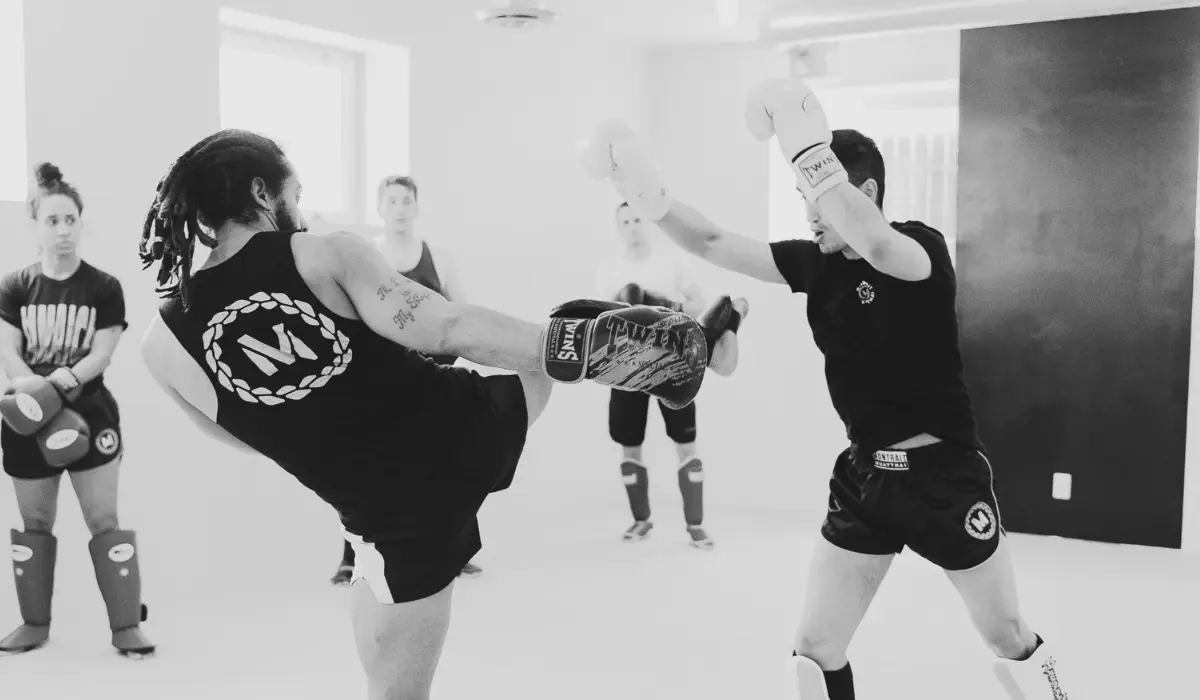
Unlike traditional sparring, which often involves full gear and high speed, technical sparring slows the exchange down. The goal isn’t to “win the round” but to learn from it. Both partners work at a light, intentional pace, focusing on distance, rhythm, accuracy, and decision-making rather than power.
This shift in mindset transforms sparring from a stressful experience into an educational one.
Why Technical Sparring Is So Effective
Technical sparring plays a big role in how students grow inside any solid Muay Thai Toronto program.
1. Learn the Rhythm of a Real Fight
Muay Thai has a natural rhythm, a flow and technical sparring teaches you how to feel it. Partners move together, attacking and responding like a conversation. This helps you understand who controls the pace and how to disrupt your opponent’s timing.
2. Build Accuracy and Control
With less chaos, you can think clearly and place your shots deliberately. You learn how to land cleanly without hurting your partner and how to avoid collisions with smart defensive reactions.
3. Increase Skill Repetition Without Damage
The more repetitions you get, the faster your fight IQ develops. Technical sparring gives you hundreds of realistic exchanges without the cost of injury, fatigue, or survival-mode stress.
4. Sharpen Feints, Setups, and Reactions
A slower pace allows you to practise drawing out defensive reactions and exploiting them. This is the foundation of high-level Muay Thai.
5. Build Confidence for Beginners
New students can inoculate themselves to the intensity of sparring. When you know the pace is light and controlled, fear drops and learning skyrockets.
6. Realistic Contact for Advanced Students
Experienced practitioners, especially those sparring without shinguards learn to stay calm while weapons come at them with minimal padding. This builds composure and authentic defensive habits.

Best Practices for Technical Sparring
- Start with shinguards and no gloves. Nails clipped, palm strikes only, fingers pulled back to avoid pokes.
- Match your partner’s rhythm. Think of it like a conversation, not a fight, but an exchange of ideas.
- Slow everything down. Aim for 50–60% pace while focusing on clean technique and clear intention.
- Avoid shin-to-shin collisions. Reduce impact by flexing the leg or slightly internally rotating on contact.
- Underreact rather than overreact. Excessive movement leads to openings and unnecessary collisions.
- Maintain playful seriousness, lighthearted energy with real purpose behind every movement.
How We Use Technical Sparring at Our Toronto Muay Thai Gym
At Montrait Muay Thai, technical sparring is woven directly into how we train. We often use it as a warm-up before full sparring rounds because it gets students thinking about timing, rhythm, and clean technique without the stress of heavy contact. It’s also one of the best tools we have for integrating newer students into sparring. Instead of being thrown straight into fast, high-pressure rounds, they get a safe, structured way to learn the flow of real exchanges.
We also use technical sparring as a cool-down at times, especially because it allows for meaningful practice without adding unnecessary damage or fatigue. Students get the chance to rack up a huge number of quality repetitions building a bigger and more adaptable “movement database” while staying relaxed and injury-free.
In short, technical sparring isn’t just something we do occasionally; it’s a core part of our training philosophy. It keeps the learning curve steep, the injury rate low, and the art of Muay Thai accessible to everyone on the mats.
Start Your Muay Thai Training In Toronto Today
Start your journey at Montrait Muay Thai and learn real technique in a supportive Toronto community. Train with coaches who focus on timing, control, and skill development so you can grow with confidence. Contact us today for a free consultation.