
What Most People Get Wrong About Muay Thai Conditioning
If your gas tank dies in round two, it’s tempting to assume you just need to “get fitter.” So you add more runs, more circuits, more suffering. And somehow… you still feel flat when the pace spikes. Worse: your shins, hips, or low back start complaining long before your lungs do.
You’re Not Lazy. You’re Just Training the Wrong System.
Most driven athletes I see, as a Muay Thai coach in Toronto, are consistent. They hit pads, they spar, they run, and they’ll do whatever the program says.
But they also describe a familiar pattern:
- They can “work hard” for a long time… until the round turns into a scramble
- They feel fine in training, then drown under fight-paced exchanges
- They keep adding conditioning, and their joints get crankier, not stronger
That’s not a willpower issue, but a system-design issue.
The Dominant Myth: “Conditioning = Making Yourself Tired”
The common advice sounds logical: Muay Thai is hard, so I need hard conditioning. Which usually becomes random HIIT circuits, endless bag “burnouts,” and running until your legs feel like concrete.
The problem is that fatigue isn’t a training method. It’s a side effect. If you don’t know which energy system you’re targeting, and why, you get really good at being tired… without getting reliably better at fighting.
The Core Concept: Condition the Bottleneck, Not Your Ego
Muay Thai rounds are a repeat-effort problem: sustained output with short bursts of chaos.
That means you need conditioning that builds three overlapping capacities:
- Aerobic base (recovery between bursts and between rounds)
- Threshold / “high sustainable pace” (how hard you can work without spiraling)
- Alactic power (short explosive bursts without turning everything into sludge)
Now the only thing left is finding the right mix for you.
Three Engines, One Chassis
Think of your body like a hybrid powertrain:
- The aerobic engine is the big, efficient motor: not flashy, but it keeps the whole system stable.
- The threshold engine is cruising speed under load—fast enough to matter, sustainable enough to repeat.
- The alactic engine is the turbo: brief, violent acceleration.
Most people keep slamming the turbo… while the cooling system is undersized. Then they wonder why performance overheats in round two.
How Incorporate Them into Muay Thai Training:
Here are the conditioning methods that actually map onto the demands of the sport:
1) Aerobic Base: Easy Roadwork (Yes, Still)
Easy runs (or bike/row) build the recovery engine: better between-round recovery, better bounce between exchanges, and less “panic breathing.” This is why roadwork remains a staple in fight sports culture—even if it’s not “sexy.”
How it should feel: conversational pace, nose-breathable, you finish fresher than you started.
What it’s for: recovery capacity, durability, repeatability.
2) Tempo / Threshold: Controlled Hard, Not Max Hard
This is the missing link for a lot of Muay Thai athletes: efforts that are uncomfortable but repeatable. Think 12–25 minutes total of work in chunks (e.g., 3–5 minute blocks) where you can’t chat, but you’re not sprinting.
How it should feel: “I can hold this, but I don’t want to.”
What it’s for: raising the pace you can sustain without falling apart.
3) Fight-Specific Intervals: Pad/Bag Rounds With Intent
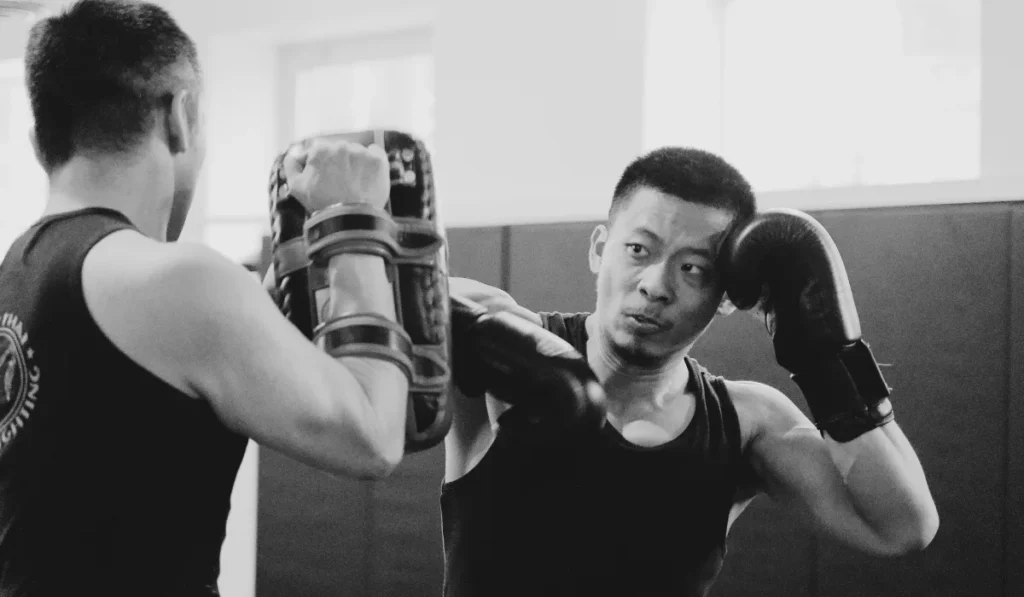
Pads and bag work are already conditioning tools when you structure them like a mechanical test: consistent round length, consistent rest, measurable output. Thai pad work and heavy bag training are cornerstone methods in Muay Thai preparation for exactly this reason.
Examples that work:
- 3 min on / 1 min off × 5–8 rounds (quality stays high)
- “Density” rounds: fixed time, fixed combo themes, track total reps
What it’s for: specific endurance + skill under fatigue (not just exhaustion).
4) Alactic Power: Short Sprints, Long Rest
If your issue is that you can’t explode repeatedly (hard entries, flurries, clinch turns), you need brief, high-power efforts with enough rest to stay powerful.
Examples:
- 6–10 second hill sprint / 60–90 seconds rest × 8–12
- 10-second bag blitz / 50–70 seconds easy movement × 8–10
What it’s for: preserving explosiveness without building junk fatigue.
5) Clinch Conditioning: The “Grip + Posture Tax”
Clinch is uniquely expensive: posture, isometrics, and repeated off-balancing. If you only run and do circuits, you’re not paying the same tax.
Better options:
- Timed clinch rounds with constraints (pummel + posture + turns)
- “Isometric repeats” (short holds, frequent resets) that don’t trash your neck
Find Your Conditioning System’s Weakest Link:
You likely need more aerobic base if:
- Your breathing stays high long after rounds end
- You feel “gassed” even when you’re not working that hard
- You struggle to recover day-to-day
You likely need more threshold work if:
- You can go easy forever, but moderate-hard pace crushes you
- You fade halfway through a round even without big sprints
- Your output drops sharply after the first exchange
You likely need more alactic power if:
- Your first burst is great, the second is trash
- Your footwork gets heavy after a few hard entries
- You avoid explosive exchanges because they “cost too much”
How to Sequence a Good Conditioning Routine?
Good conditioning is sequenced, not stacked:
- Build the aerobic engine so you can recover
- Raise threshold so your “default pace” climbs
- Add alactic power so bursts stay sharp
- Use pads/bag/clinch as specific tests, not punishment
This is the same logic we use in assessment-driven coaching: identify the bottleneck, apply the minimum effective dose, retest, and progress based on what changes—not what feels heroic.
Condition Correctly at Montrait Muay Thai
If your Muay Thai conditioning hasn’t translated, don’t assume it’s because you’re not fit. Assume your system is mis-specified.
When your training methods match the energy demands of the sport, and your current constraint, you don’t just last longer. You fight clearer, you move cleaner, and you stop paying for fitness with your joints.
At Montrait Muay Thai, we build your conditioning through skill work, pad rounds, and structured drills. We build repeatable output, not burnout workouts.Book a call and tell us your goals and training history. One of our coaches will map out your first month of training.