
If you are searching “Muay Thai back pain,” you are probably wondering whether it is safe to start training.
Maybe your lower back gets stiff after sitting at a desk all day. Maybe you have had back pain in the past and you are nervous about kicking, punching, twisting, or clinching. Or maybe you tried a Muay Thai class before and hurt your back afterward.
So, can you train Muay Thai with back pain?
For many beginners, the answer is yes BUT the way you start matters.
Muay Thai is a physical sport. It involves mobility, stability, balance, footwork, core endurance, cardio, and full-body coordination. If your body is not distributing load well, your back may end up doing more work than it should
That does not automatically mean Muay Thai is bad for your back. It may mean your body needs a better entry point into training.
Why Does My Back Hurt During Muay Thai?
A lot of beginners assume that back pain means their back is weak.
Lower back pain means “I need to strengthen my back.” Knee pain means “I need stronger knees.” Shoulder pain means “I need stronger shoulders.”
Sometimes that is part of the picture. But the painful area is not always the weak link.
In Muay Thai, your body needs to work as a connected system. When you throw a kick, your lower back should not be the only area creating rotation. Your feet, hips, trunk, and shoulders all need to contribute. When you punch, power should transfer from the floor through the legs, pelvis, trunk, shoulder, and arm. When you knee, check, pivot, or defend, your body has to manage balance and force under changing conditions.
If one part of the system is not contributing well, another area has to pick up the slack.
Very often, the lower back becomes the overworked area.
That does not mean your back is “bad.” It means your movement strategy needs to change.
Muay Thai Back Pain Is Often a Coordination Problem
When people hear the word “coordination,” they usually think of being naturally athletic, fast, or graceful.
But for back pain, we are talking about coordination in a mechanical sense: does your body share load or transfer force well? Are the right joints and muscles contributing at the right time?
For example, if your hips cannot rotate freely, your back may feel tight after punching or kicking. If your stance isn’t balanced, your torso may brace excessively. If you are holding your breath or tensing too hard, your body may become too stiff to move smoothly.
This is why simply strengthening your lower back does not always solve the problem.
If the same overload pattern remains, the pain often comes back.
Is Muay Thai Safe for Beginners With Back Pain?
Muay Thai can be safe for beginners with back pain when the training is scaled properly.
The problem is not usually Muay Thai itself. The problem is being thrown into a class environment before your body has learned how to handle the positions, movements, and intensity.
A beginner with back pain may struggle if they are expected to keep up with everyone right away. They may not know how to stand, pivot, kick, punch, brace, breathe, or defend efficiently. Under fatigue, the body usually falls back into its strongest compensation patterns.
For many people, that means the lower back does too much.
This is why your starting point matters.
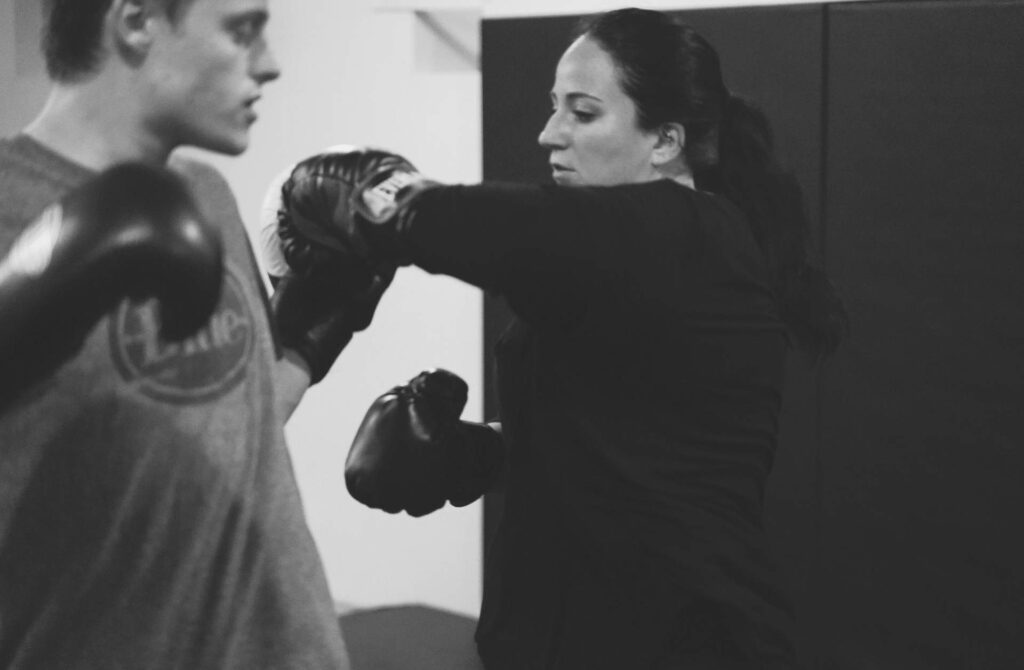
How Our IPS Helps Beginners With Back Pain
At Montrait Muay Thai, we do not believe in a sink-or-swim approach for beginners.
Our process starts with a consultation, followed by an Initial Performance Session, or IPS. The IPS is a 75-minute one-on-one session designed to understand how you move before we simply throw you into group training.
For someone dealing with back pain, we are not only asking, “Where does it hurt?”
We are looking at what your body is being asked to do too much of.
That may include your stance, hip rotation, trunk control, balance, footwork, kicking mechanics, punching mechanics, posture, breathing, or how you brace when learning something new.
The purpose of the IPS is to identify whether your back is truly the weak link, or whether it is compensating for something else.
Foundations For Muay Thai in Toronto
After the IPS, many beginners move into our Foundations program.
Foundations is a series of ten one-on-one sessions that teaches the fundamentals of Muay Thai in a structured, personalized way. Think of it as private tutoring for your body and your technique.
Instead of trying to survive a group class while worrying about your back, you learn step by step.
You learn how to stand, move, punch, kick, defend, and condition your body with better mechanics. You receive coaching specific to your body, your goals, and your current limitations.
For someone with back pain, this can make a major difference.
The goal is not to avoid hard training forever. The goal is to prepare your body to train well.
Muay Thai should challenge you. It should build strength, conditioning, skill, and confidence. But the challenge should be scaled intelligently so your body learns how to distribute work better.
Build Confidence With Beginner Muay Thai
If you are worried about training Muay Thai with back pain, it does not mean you are too weak, too injured, or too out of shape to start.
It may simply mean you need a better assessment and a better entry point.
Back pain often shows up where compensation accumulates. It is not always where the story starts.
At Montrait Muay Thai, our IPS and Foundations process helps beginners understand how their body moves, reduce guesswork, and build the confidence to train properly.
Because the goal is not just to get through your first class.
The goal is to build a body that can train, improve, and enjoy Muay Thai for the long term.
Book a no-sweat consultation call with us to talk through where you are at and what your fitness goals look like. There is no pressure and no commitment, but an opportunity to learn about how our training can help you reach your goals.
If you are searching “common Muay Thai injuries,” you are probably not looking for a reason to avoid training.
You are looking for a reason to start intelligently.
Maybe your back already gets tight from sitting. Maybe your shoulders feel stiff after work. Maybe your knees ache when you run, your shins flare up with impact, or your wrists feel uncomfortable when you do push-ups. You want to learn Muay Thai, but you do not want to turn a manageable ache into a bigger problem.
That concern is reasonable.
Muay Thai involves punching, kicking, kneeing, elbowing, rotating, balancing, impact, and fatigue. Injuries are not random. They usually happen when the body is asked to produce or absorb more force than it can currently control.
If any symptoms are sharp, worsening, radiating, associated with numbness, or affecting daily life, get assessed by a qualified healthcare professional before continuing training.
The goal is not to avoid all risks. The goal is to understand where risk comes from and make the body stronger in the right order.
Here are 5 Common Muay Thai Injuries in Beginners And How To Prevent Them:
1. Back Pain
Back pain is one of the most common concerns for adults starting Muay Thai.
Round kicks, punches, knees, and defensive movements all involve rotation. If the hips do not rotate well, especially into hip internal rotation, the low back often makes up the difference. Over time, that can turn the back into the “compensation zone.”
Poor core endurance can also contribute. This is not just about having visible abs or being able to hold a plank. It is about whether your trunk can maintain position, breathing, and control over repeated rounds. When fatigue builds, the ribs may flare, the pelvis may shift, and the low back may absorb force that should be distributed through the hips and trunk.
How to Treat:
- Reduce provocative movements: Pull back on high kicks, hard rotation, and any movement that directly triggers symptoms.
- Rebuild gradually: Reintroduce with lower-intensity drills before returning to full training load.
- Identify the root cause: Resting until pain calms down is not enough. Understand why the back was overloaded in the first place.
How to Prevent:
- Hip Mobility: Build usable hip rotation, especially internal rotation, so the low back is not compensating for a stiff hip.
- Core Endurance: Train the trunk to maintain position, breathing, and control across multiple rounds, not just in isolation.
- Kick Mechanics: Learn to kick through the hip instead of twisting through the low back.
- Load Management: Progress kicking height, power, and volume gradually rather than all at once.
2. Neck and Shoulder Pain
Many beginners already spend hours in rounded positions: sitting at a desk, driving, cooking, typing, or looking down at a phone.
Then they enter a Muay Thai stance: hands high, chin tucked, elbows in, shoulders active. This position is important defensively, but it can exaggerate existing neck and shoulder tension.
If the upper back is stiff and the shoulder blades do not move well, the rotator cuff may have to work from a poor base. The shoulder is like a crane mounted on a platform. If the platform is unstable, the moving arm has to compensate.
How to Treat:
- Reduce punching volume: Pull back if symptoms are increasing rather than pushing through.
- Avoid loading an unstable shoulder: Stay off heavy bag and pad rounds if the shoulder feels pinchy, weak, or unstable.
- Restore range first: Comfortable shoulder range, upper-back motion, and neck control should come before adding more speed or power.
- Seek assessment: Persistent pain, weakness, numbness, or pain that disrupts sleep warrants professional evaluation.
How to Prevent:
- Posture Tolerance: Build the capacity to hold a guard position without shrugging or tensing the neck.
- Upper Back Strength: Strengthen the upper back, rotator cuff, and shoulder blade control to give the shoulder a stable base.
- Punch Mechanics: Learn to support punching through the trunk, hips, and footwork rather than relying on the shoulder alone.
- Progressive Load: Build punching mechanics gradually before increasing speed or power.
3. Ankle Pain, Knee Pain, and Shin Splints
Footwork, skipping, kicking, pivoting, and conditioning all expose the lower body to repetitive impact.
The foot and ankle are the first contact points with the floor. If they do not absorb and redirect force well, stress travels up the chain into the shins, knees, hips, or back.
Balance matters here. Not just standing on one leg, but controlling pressure through the foot while moving. If the foot collapses, stays too rigid, or cannot adapt to the floor, the shin and knee may take more load than they can tolerate.
Shin splints often happen when training volume increases faster than the tissues can adapt.
How to Treat:
- Reduce impact volume: Modify skipping, running, jumping, and high-repetition kicking while symptoms are present.
- Ice irritated shins: Apply ice if it helps manage symptoms during the acute phase.
- Reintroduce load gradually: Do not return to full volume until the area can tolerate it without flaring.
- Seek assessment for acute injuries: If you cannot bear weight, the joint feels unstable or numb, pain is directly over bone, or symptoms are severe, get assessed professionally.
How to Prevent:
- Foot and Ankle Strength: Build the capacity to push through the floor without collapsing inward or gripping excessively.
- Single-Leg Balance: Improve control under load, not just static standing.
- Load Management: Progress skipping, pivoting, and kicking volume slowly to give tissues time to adapt.
- Footwear: Good footwear outside the gym matters if daily walking or work demands already irritate your shins or knees.
4. Sprained Wrist
Wrist injuries often happen when beginners punch with poor alignment or hit harder than their structure can support.
A punch is a force-transfer problem. Power should move from the floor, through the legs, hips, trunk, shoulder, arm, and fist. If the wrist bends on impact, the force does not travel cleanly. The wrist becomes the weak link.
Wraps and gloves help, but they do not replace technique.
How to Treat:
- Stop punching through wrist pain: Reduce impact work and avoid heavy bag or pad rounds until the wrist can tolerate basic loading.
- Early care for acute sprains: Rest, ice, compression, and elevation in the first few days.
- Seek assessment: Major swelling, bruising, loss of grip strength, deformity, numbness, or pain that does not improve warrants professional evaluation.
How to Prevent:
- Fist Position and Alignment: Learn correct wrist alignment and knuckle contact before increasing power.
- Hand Wraps and Gloves: Use properly fitted gloves and hand wraps consistently.
- Earn harder punching: Progress contact through clean mechanics, not enthusiasm.
5. Concussion
Concussion is the injury many beginners worry about most when they hear “combat sport.”
That concern should be respected.
At Montrait Muay Thai, beginners do not spar on day one. Sparring only occurs at the yellow shorts level, after students have developed enough technical control, defensive awareness, and coach approval to participate more safely.
Concussion risk is not about toughness. It is about exposure, control, defensive skill, decision-making, and preparation.
Reactive neck stability also matters. The neck helps control how the head moves when force is applied. This does not make anyone concussion-proof, but better neck strength, posture, awareness, and reaction can be part of a broader risk-reduction strategy.
How to Treat:
- Stop immediately: If a concussion is suspected, stop training that day. Do not return to sparring, drilling, or conditioning.
- Monitor symptoms: Headache, dizziness, nausea, light sensitivity, balance issues, fogginess, slowed thinking, or memory problems all warrant attention.
- Supervised return: Return to sport should be gradual and managed by a healthcare provider.
How to Prevent:
- Delay sparring: Sparring should be earned technically, not handed to beginners on day one.
- Build defensive skill first: Distance control, composure, and reaction come before unpredictable contact.
- Neck Stability: Strengthen and build awareness in the neck as part of broader injury-reduction work.
- Controlled sparring environment: Keep sparring supervised, controlled, and appropriate to the athlete’s current level.
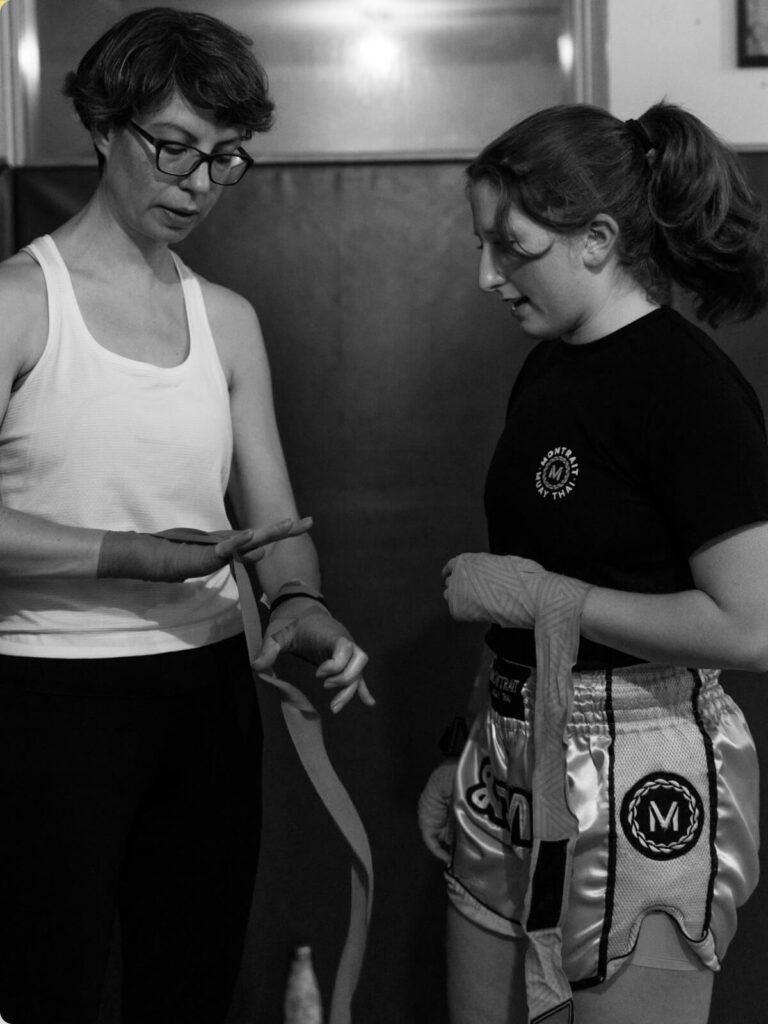
How Montrait Muay Thai Reduces These Risks
The biggest mistake beginners make is starting with intensity before understanding their mechanics.
This is why our Toronto Muay Thai gym developed the Initial Performance Session (IPS) and Foundations curriculum: to help reduce injury risk by giving each new student an individualized starting point.
During the IPS, instead of assuming every beginner moves the same way, we look at how you rotate, balance, brace, breathe, strike, and tolerate basic Muay Thai positions. This helps identify root contributors behind existing aches and pains, rather than only reacting to symptoms.
From there, the 1-on-1 Foundations program builds technique progressively. You learn stance, footwork, punching mechanics, kicking mechanics, defense, balance, and control before being expected to keep up in a faster group environment. If your hips are limiting your kick, we address it. If your shoulders are tense in stance, we coach it. If your wrists need better punching structure, we slow the movement down. If your conditioning drops your technique, we progress volume carefully.
Muay Thai should challenge your body, not punish it for being unprepared.
When the starting point is assessed and the progression is coached, beginners can build skill, confidence, and resilience at the same time.
Start with a free intro call today!